“Green cleaning” is more than a marketing label on a bottle. For Edmonton facility managers, it is a practical way to protect occupant health, meet tenant expectations, and keep hard floors, carpets, and restrooms in good condition without harsh chemistry that damages surfaces or triggers complaints.
If you oversee office cleaning, medical clinics, schools, or multi-tenant buildings, this guide explains what to look for in products, how to verify claims, and how to align green choices with your janitorial contract.
What “green” actually means on a label
There is no single legal definition of green cleaning in Canada, so facility managers need a short checklist:
- Third-party certification — Look for recognized programs (for example, EPA Safer Choice in the U.S., or EcoLogo / UL solutions in Canada) that review ingredients and performance, not just packaging.
- Ingredient transparency — Full disclosure or safety data sheets (SDS) available; avoid vague terms like “proprietary blend” when you need to assess asthma or fragrance sensitivities.
- Performance on your surfaces — A product can be low-toxicity and still fail on Edmonton office carpet, VCT, or stone if it is not formulated for that use.
- Concentrate vs ready-to-use — Concentrates reduce plastic and shipping when dilution is controlled; ready-to-use simplifies training but costs more per litre.
Green does not mean “water only.” It means lower hazard, verified claims, and methods that work in real commercial settings.
Why facility managers care beyond sustainability
Tenants and employees increasingly ask what is used in their space. Green-oriented programs support:
- Indoor air quality — Lower volatile organic compounds (VOCs) and fewer strong fragrances can reduce headaches and respiratory irritation in sealed winter buildings.
- Surface life — pH-balanced, manufacturer-approved products help protect finish on hard floors and avoid residue that attracts soil on carpet.
- Safety — Clear labeling, proper dilution, and compatible disinfectants reduce chemical mixing mistakes during flu season or outbreak response.
- Reputation — Property managers can document product lists for LEED-oriented tenants or corporate ESG reporting without greenwashing.
The goal is a documented program, not a single “eco” product swapped in once.
Disinfection: green does not mean skipping kill claims
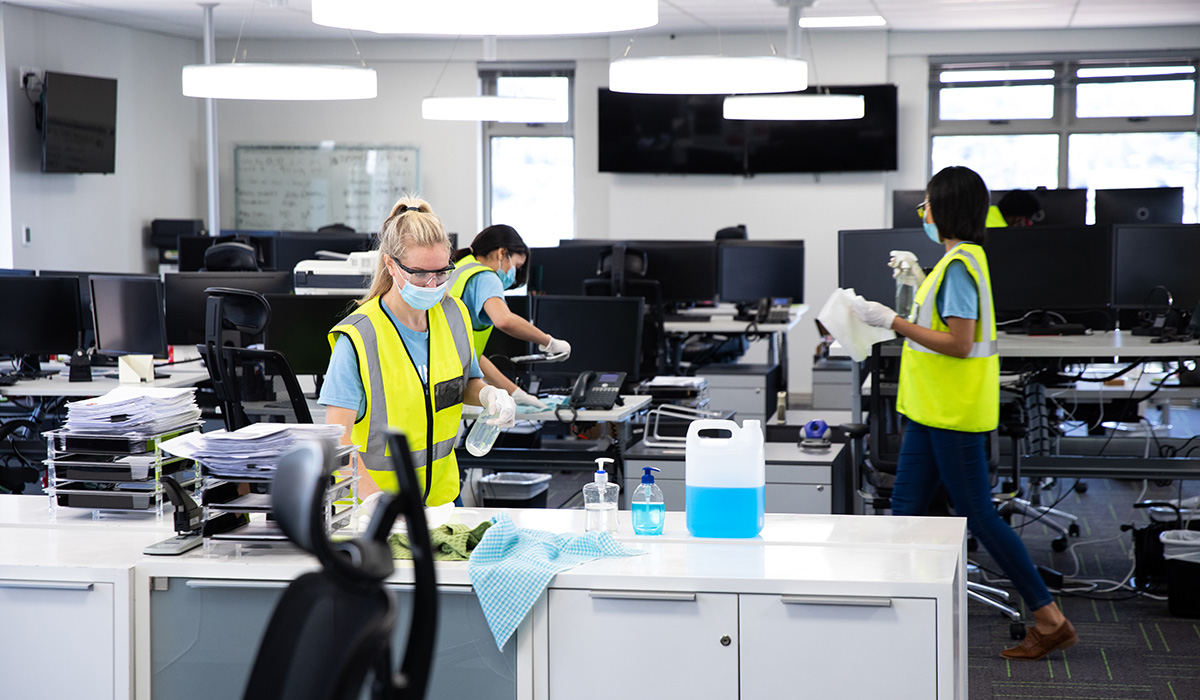
During cold and flu season, Edmonton workplaces still need Health Canada–registered disinfectants where regulations and your infection-prevention plan require them. Green-minded programs:
- Use disinfectants only on listed surfaces and only when needed (high-touch, restrooms, outbreak protocols)—not on every desk every night.
- Respect contact time on the label; wiping too soon is a common failure in both traditional and green programs.
- Pair disinfection with cleaning first (remove soil so disinfectant can work).
Electrostatic or spray-and-wipe methods each have a place; the product label and your janitorial scope should match the method.
Dilution control and training
The biggest green-cleaning failure in commercial buildings is overuse of concentrate—“more chemical equals cleaner.” That wastes product, leaves sticky residue, and can void floor warranties.
Best practices:
- Closed-loop dilution systems or colour-coded bottles with fixed ratios
- Written procedures per area (restroom, kitchen, general office)
- Refresher training when products change or new staff join
- Spot checks during quality walks—not just visual inspection of trash and floors
Your janitorial partner should be able to show you the product list, dilution charts, and where SDS files live.
How to evaluate a new green product before full rollout
Pilot in one floor or after-hours zone for two to four weeks:
- Appearance — No haze on glass, no rapid re-soiling on vinyl or LVT
- Odour — Acceptable to a sample of occupants (fragrance-free is often best in mixed-tenant buildings)
- Compatibility — Confirm with flooring and carpet manufacturers if you are under warranty
- Labour — Does the product require extra dwell time or passes? Factor that into scope and pricing
- Waste — Can concentrates or larger refills reduce single-use plastic?
Document results so you can answer tenant questions with specifics, not slogans.
Working green choices into your janitorial contract
When you renew or scope commercial cleaning in Edmonton, ask for:
- A master product list with certifications noted
- Substitution policy — how and when products change, with notice to you
- Green cleaning options as a defined line item (not an undefined “we use green stuff”)
- Quality assurance visits that include chemical storage, labeling, and dilution stations
Bluebird Janitorial builds customized cleaning plans around your building type, traffic, and product preferences—including greener lines where they meet performance standards.
Bottom line
Green cleaning products are a tool for healthier buildings and longer-lasting finishes, but only when certification, dilution, disinfection rules, and staff training line up. Facility managers who treat product selection as part of quality assurance—not a one-time purchase—get fewer complaints, clearer tenant conversations, and better outcomes through Alberta’s dry winters and busy flu seasons.
Need a commercial cleaning partner that documents products and procedures? Contact Bluebird Janitorial today for a free quote. Call 780-458-7825 or request a quote online — we will walk your space with you and recommend a scope that fits your building and product goals.